
We often hear that "talking about yourself" is the best way to learn English. This is called Self-reference , and it’s highly effective.
However, what if you run out of things to say about yourself? Today, we’ll explore Storytelling Methods that don't rely on your own life but still make English stick in your brain!
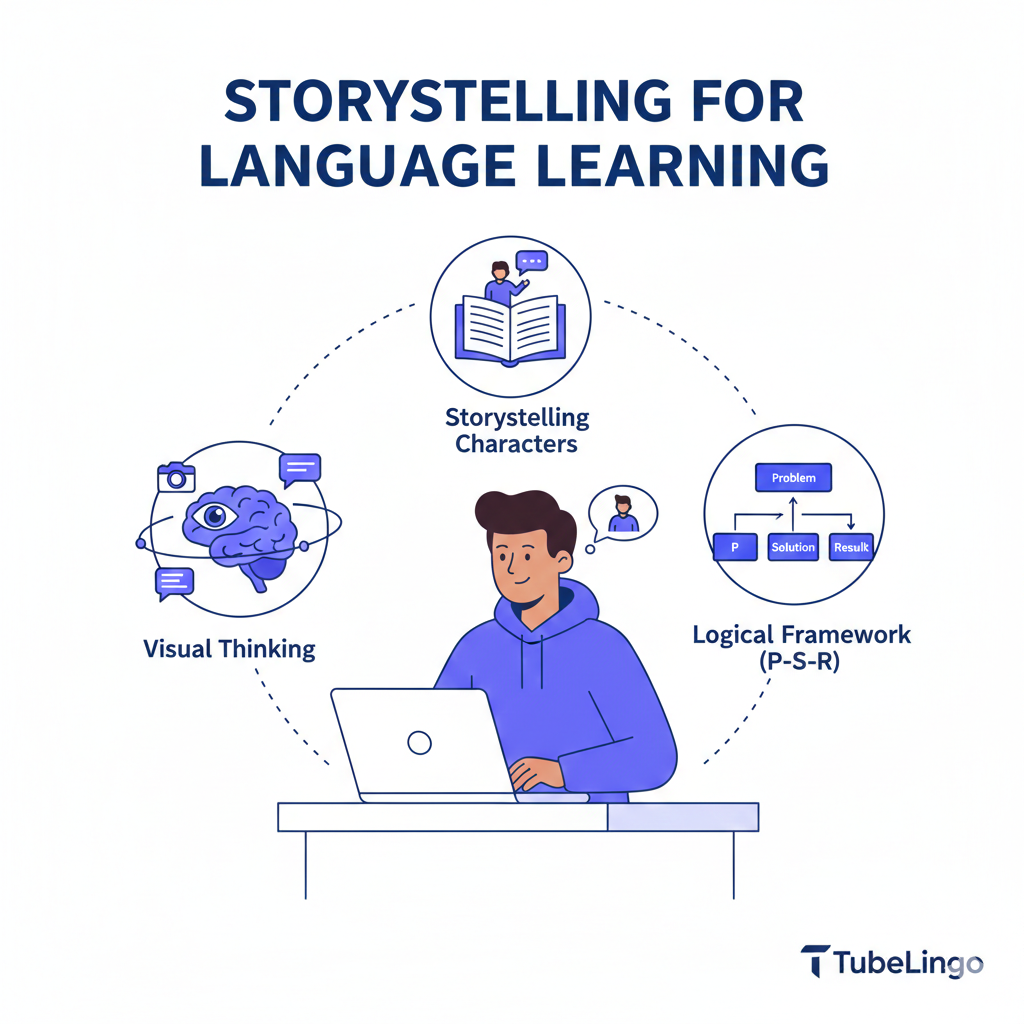
Link words to "Core Images" rather than translations.
1. Link to "Visuals" instead of "Text" (Core Image Method)
Stop memorizing translations. Instead, connect words directly to their "Core Image."
- How to do it:
- Image Search: Search for a word (e.g., feasible) on Google Images to burn the visual concept into your mind.
- Movie Screenshots: Save a scene with its dialogue. This links the emotion and context to the language.
- The Effect: The brain processes visuals much faster than text, making the English more "retrievable" in real conversations.
2. Character "Role-play & Reconstruction" (LBS Method)
Use LBS (Learning by Storytelling) by stepping into a character's shoes.
- How to do it:
- Speech Bubble Filling: Look at a storybook and think, "What would this character say here?"
- Retelling: Summarize a story you’ve read or heard in your own words.
- The Effect: Using existing stories provides a "scaffold," helping you build natural English without getting stuck on direct translations.
3. "Logical Storytelling" for Business (P-S-R Framework)
In business, a logical flow is just as important as the language itself.
- The P-S-R Framework:
- Problem: Describe the challenge you faced.
- Solution: What action did you take?
- Result: What was the outcome (ideally with data)?
- The Effect: Presenting your work as a "story of problem-solving" is far more persuasive and memorable than just listing facts.
Bonus Tips for Growth
- Process Simulation: Instead of imagining the "end result" (speaking perfectly), visualize the process—how you choose words and use gestures.
- Chunk Learning: Don't learn isolated words; learn "Chunks" like "It is feasible to..." to improve your fluency instantly.
Summary
By using visuals, characters, and logical frameworks, you can make your English practice more diverse and effective. Why not try one of these methods today?
Practice what you learned.
Why not try writing a diary using the phrases you learned?
Our AI Tutor will correct your English to sound more natural.