Introduction: Why Does Our "Studying" Always Stall?
Do you ever feel like phrases get stuck in your throat despite reviewing vocabulary books countless times? Or that textbook examples are too far removed from your reality to be interesting? This sense of stagnation in language learning isn't due to a lack of effort; it stems from a mismatch in learning design.
As digital natives, we use digital tools effortlessly. Yet, when it comes to language learning, we suddenly power down our smartphones and retreat to the static world of paper. Modern EdTech research and language pedagogy suggest a different truth: the real hints for living language are found outside the classroom walls, hidden within the "noise" of the digital spaces we interact with daily.
This article presents four perspectives that fundamentally overturn the traditional concept of "studying." It's not just about efficiency—it's about radically updating how you engage with the world of language.
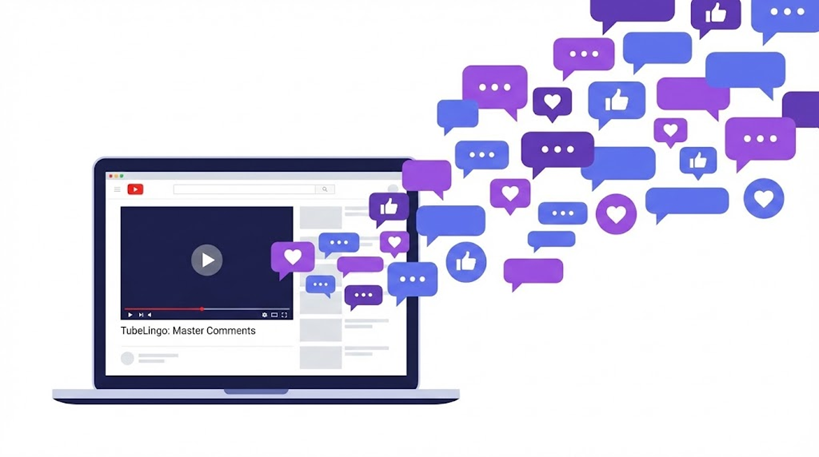
The digital space is overflowing with living language.
1. YouTube Comments Are the World's Most Dynamic "Living Textbook"
Many people just casually scroll through YouTube comments after watching a video. However, from a sociolinguistic perspective, this is a highly exciting laboratory for "Input Enhancement," where countless people continuously reconstruct language.
Research (e.g., Aldukhayel, 2021) emphasizes that the YouTube comment section is a space for "Multilayered Enhancement (Combination)," generating multiple learning effects simultaneously. Three phenomena create a powerful synergy here:
- Salience: Catchy phrases from the video are repeated by multiple users, maximizing their visual frequency and forcing a mental "hook."
- Modification: Difficult colloquialisms or jargon are paraphrased or translated by other users, removing comprehension barriers in real-time.
- Elaboration: Cultural knowledge and relevant anecdotes behind the context are supplemented by the community, creating a deep network of meaning.
Reading comments isn't just passive consumption; it's decoding the ultimate personalized learning material, where the collective intelligence of users adds multi-layered "visual annotations" to the auditory information of a video.
2. There Are 5 Shades to "Knowing" a Word
Treating vocabulary as a binary "I know it" or "I don't know it" overlooks the richness of language learning. According to metrics from "Lexinote" (Tanaka et al., 2014)—an e-portfolio system designed to break the barriers of classroom time—vocabulary knowledge should be viewed as a 5-stage continuum of "Familiarity."
- I have seen the word. (Intuition)
- I know its form (spelling/sound) and meaning. (Recognition)
- I can translate it from my native language. (Translation)
- I can recall it within a sentence. (Contextualization)
- I can use it freely in conversation. (Expression)
The crucial insight here is that these 5 stages are "not a linear staircase." Vocabulary knowledge is a dynamic continuum that even includes forgetting and regression.
A word you used perfectly in a level 4 context yesterday might regress to a level 2 "I've seen it" today. Embracing this fluctuation and using metacognition to track your current standing—enjoying the "shimmering" nature of knowledge—is the engine of sustainable learning.
3. The Goal of Language Learning is Not "Correctness," but Finding a "Place"
Modern language education research highlights that beyond the pursuit of grammatical "correctness" lies learning connected to real-world communities. Language has transformed into a "weapon" for establishing personal identity.
Whether it's the life story of a migrating LGBTQ+ individual seeking words to express their diversity, or the educational activities taking place in an ethnic "Nepali restaurant" serving as a community hub, language is a tool for social participation.
The true purpose of learning a language is not to update test scores, but to connect with others and secure a "place" where you can express your expertise and unique identity.
4. Technology Exists to Accelerate "Dialogue"
Computer-Mediated Communication (CMC) features, like those in Lexinote or YouTube comment sections, are not merely efficiency tools. Based on modern interaction theories, learning is reinforced through continuous "dialogue" with computers and others.
The goal is not simply to master the tool, but to maintain a cycle of receiving feedback and outputting your inner thoughts. This cycle grants learners "Autonomy in expression." The ultimate value of technology is empowering us to control our learning and face the world with our own words.
Conclusion: Hack the "Raw Voices" of YouTube with TubeLingo
The era of viewing language learning as the "hard labor" of textbook memorization is over. Future learning is a process of self-exploration in the vast sea of digital language.
"But YouTube comments are full of slang and hard to read..."
That's where TubeLingo's powerful AI Tutor comes in. By simply pasting a YouTube link into the AI Tutor Menu, the AI extracts raw comments, translates them, and thoroughly explains the underlying context and native slang that you'll never find in a textbook.
Close the textbook and dive into the dynamism beyond the screen. The comment you see on YouTube today might be the first step in expanding your world. What words will you carve out next, and who will you connect with?
Practice what you learned.
Why not try writing a diary using the phrases you learned?
Our AI Tutor will correct your English to sound more natural.