
Having given shape to "AI Career Tactician" (the fortune-telling site) with my own hands and becoming able to control it, I gained a little technical confidence. However, as I continued to operate it, one fundamental question emerged.
"Fortune-telling is certainly interesting. But is it something I or my family would want to use 'every day'?"
For the past month, I had dove into the dizzying world of AI and overcome numerous unreasonable walls by pulling all-nighters. I want to leave a record of this short but dense and "exciting experience" before I forget it. And I want to be of help to someone who wants to try using AI from now on.
Most of all, when my children grow up someday, I want them to feel, "Mom, in her 40s, took on such a crazy challenge back then. We can take on any challenge, no matter how old we get, too."
That strong desire propelled me beyond mere technical experimentation and toward developing a new service for the people I truly care about: "TubeLingo".
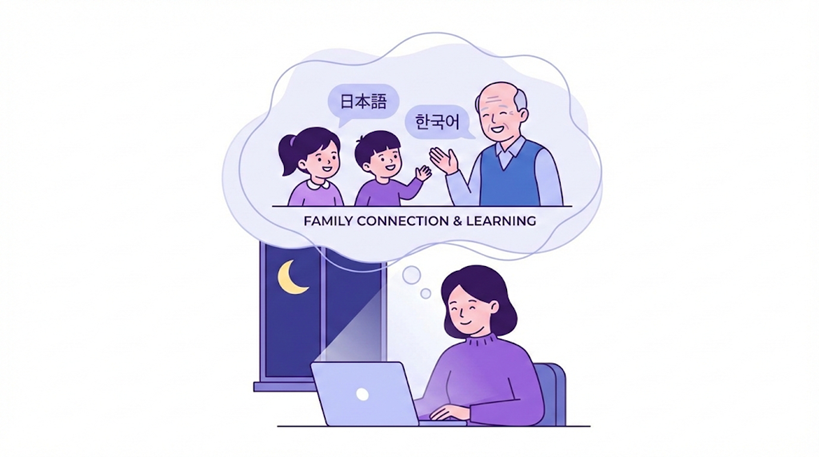
The driving force shifted from 'technology' to 'love for family'
Actually, the initial TubeLingo was envisioned to be completely different from what it is now. It was a feature where "the AI would read the entire YouTube script (subtitles) and translate/explain it sentence by sentence."
However, I hit another big wall here. It turned out that acquiring scripts from YouTube using official methods is extremely difficult. I spent mind-numbing hours day after day rewriting the source code, but in the end, I had no choice but to abandon that path.
"Another failure..."
Just as my shoulders dropped, my eyes caught the YouTube comments section, which I always looked at for my own English learning.
"Wouldn't it be more interesting to learn from the 'live reactions of locals' gathered there, rather than the video itself?"
From there, I completely changed course. When I actually gave it shape, it turned out to be something far more wonderful than the script feature. The comments section is overflowing with authentic slang not found in textbooks, sometimes slightly broken expressions, and contexts unique to that culture. The AI carefully explains all of that.
"Things don't always go as planned. But it's exactly when you're stuck that you find a more interesting path." This lesson I gained through development was invaluable, something that cannot be replaced by anything else.
Fortune-telling is something you enjoy occasionally, but language learning is a "portal" you can use every day. "If it's this, I want to use it every day. I can confidently recommend it to my kids, my grandpa (my father), and the friends around me."
My children who speak Japanese, and my father who speaks Korean. Two people with a language barrier, someday enjoying each other's country's YouTube videos and having lively conversations through this "TubeLingo". When I imagined such a scene, late-night debugging work wasn't a chore at all.
What I truly need, and what I want to deliver to my loved ones. Shaping that together with my partner, AI. The transition from "AI Fortune-Telling" to "TubeLingo" was the moment for me when the stage shifted from "acquiring technology" to "embodying my thoughts".
🍳 [Today's AI Development Recipe]
- Technical Difficulty: ⭐☆☆☆☆ (Mindset for when you hit a wall)
This time, it's a recipe for overcoming technical dead-ends with "reverse thinking."
1. What is a "Pivot" (Change of Direction)?
In development, when the feature you initially envisioned becomes impossible to realize due to technical walls, it refers to completely changing the direction of your approach without changing the goal. It is a flexible strategy of "finding another path" rather than forcefully climbing over the wall.
2. How did I do it?
The program to acquire YouTube's "subtitle data" just wouldn't work, and no matter how many times I asked the AI (Gemini), I couldn't find a solution. So, I stopped fixating on subtitles.
Actual Action: I shifted my thinking to, "If I can't get subtitles, let's have the AI read the 'comments section' and explain it," and completely rewrote the prompt for Gemini from "Translate the subtitles" to "Explain the slang and context in the comments."
3. To Our Readers
If you are trying to build something using AI and hit a wall where "the error just won't go away" or "I was told it's technically impossible," take a deep breath. By consulting (bouncing ideas off) the AI, asking "Does it absolutely have to be this feature?" or "If we look at it from another angle, is there more interesting data?", an even better idea than originally planned might be born.
Preview: The Never-Ending Challenge. And to the "Next Stage"
"For my family." "For myself." Having found a firm purpose, the lonely late-night development turned from pain to joy. AI became not just a convenient tool, but an irreplaceable partner that gives shape to my thoughts.
However, the more the service takes shape, the more new challenges become visible. "How can I make it easier to use?" "How can I separate features for adult learners and children?"
Next time, [Episode 8] The Ever-Evolving TubeLingo and the Future Walking Together with AI. Beyond the 1-month challenge, I will talk about the "true treasure" I obtained. Look forward to it!
Learn from "Real Voices" 📺
Just enter a YouTube URL.
AI explains raw comments and slang.
Practice what you learned ✍️
Why not try writing a diary?
Our AI Tutor will correct it to sound natural.