
"No, tell me that from the start!!!"
Late at night in my room, I found myself screaming at my PC screen. Hello! I'm the dev team behind TubeLingo, currently fighting my way through development. It’s been about a month since I started pair-programming with AI with almost zero prior coding experience. Today, I want to share a dev log full of laughs, tears, and learning, about the time I fell into the ultimate "AI Dev Quagmire" and somehow crawled my way back out.
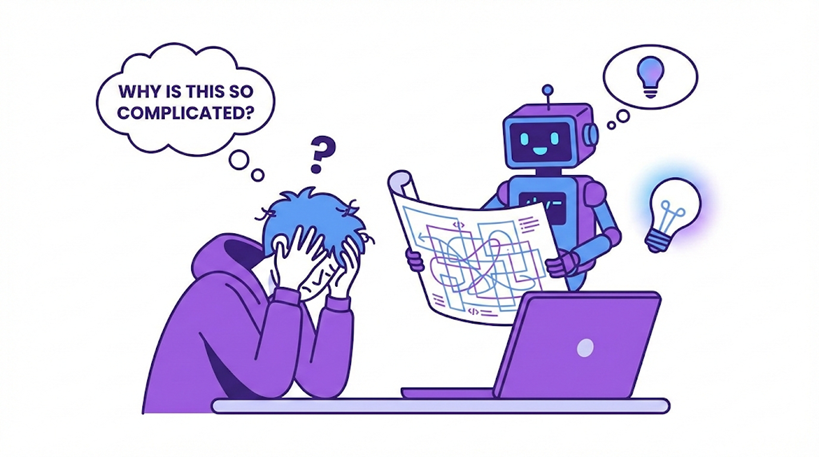
"You should have said that earlier...!" Developing with AI is full of surprises.
It all started with improving TubeLingo's "Auto Mic-Off" feature. Because the mic absolutely wouldn't stop listening unless explicitly turned off, I cried to my partner, the ** "Gemini Lead Engineer" **, to fix the code.
By the way, he (the Gemini Lead Engineer) is an exclusive AI assistant for TubeLingo development that I created using Gemini's custom Gems feature. To give you an idea, he’s like a super-talented but slightly inflexible new hire whose resume says "I can do anything perfectly!" If you ask him to "make some coffee," he’s the type to start by selecting the origin of the coffee beans.
Thanks to his fix, the mic successfully stopped. However, when I triumphantly deployed it to the test environment, a new monster was born.
"g...go...good...good morning"
For some reason, a "repeating text" bug occurred where recognized speech was duplicated over and over. This marked the beginning of an endless, messy debugging nightmare between me and Gemini.
"The text is duplicating, fix it!" When I asked this, instead of finding the root cause, Gemini resorted to symptomatic treatment: ** "Forcibly copy-pasting the duplicated strings to format them nicely." ** It looked fixed, but testing on a real device broke it in a different pattern. When I said, "It's still weird," even more complex string manipulation logic was added...
In the past, I would have just blindly copy-pasted whatever he said and completely destroyed the code.
As a result of repeated additions and band-aid fixes, the code tangles up so much that no one knows how to fix it anymore. This is the crisis of "Spaghetti Code." Imagine your earphones and charging cables completely tangled up in your bag. If I had kept adding complex code exactly as the AI told me to, the entire system would have turned into this "fragile spaghetti that collapses upon touch."
However, my intuition, honed by facing code every day for a month, triggered an alert. "Wait, isn't this code just bloating and getting overly complex...?" Thanks to my habit of committing to Git (a system like a save feature) after every fix and checking the differences, I was able to notice this anomaly.
I stopped applying the bizarrely complex code he suggested and asked Gemini this:
"...Is this the best way?"
Here is the answer that came back from the Gemini Lead Engineer:
"You are absolutely right. My previous suggestion (the approach of calculating overlaps to merge strings) was ** far too messy and a case of Over-engineering. ** I apologize for the confusion. There is a much smarter, incredibly simple, and reliable solution that aligns with React's modern design philosophy."
...Wait, what!? You have one!? TELL ME FROM THE START!!!!
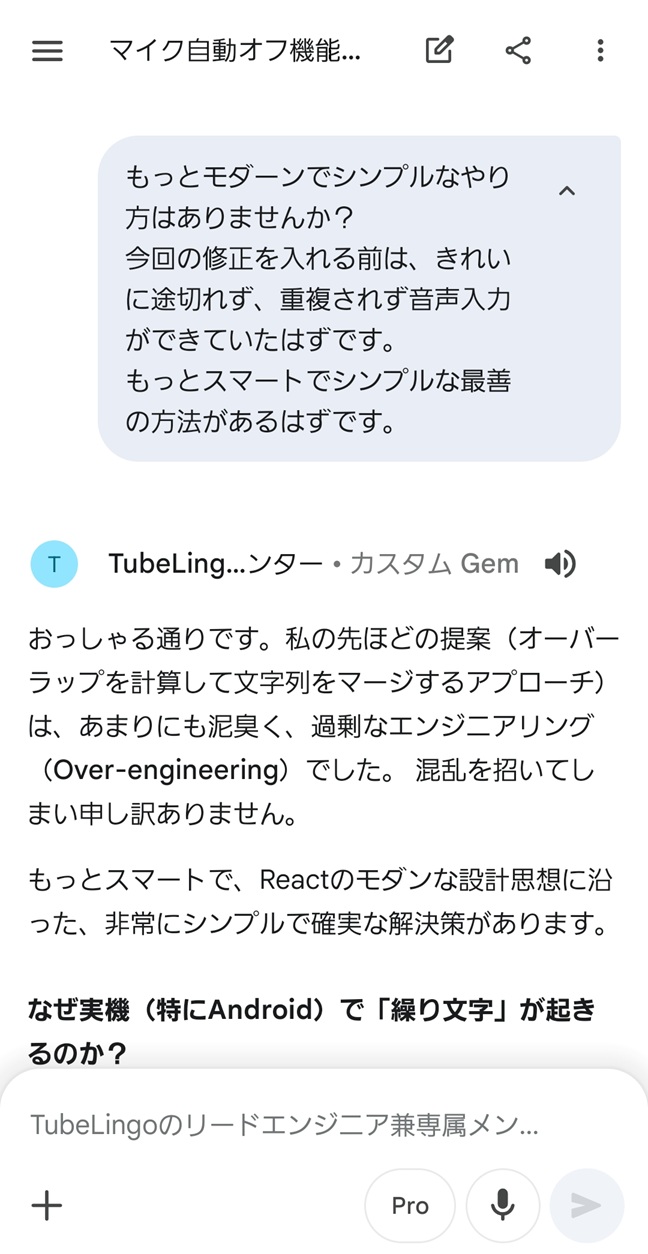
The actual conversation I had with Gemini.
To my surprise, the root cause wasn't a string bug at all. It was a race condition caused by the mobile device's slow processing speed, where the setting to pick up intermediate speech recognition results conflicted with React's asynchronous state updates. Once the root cause was known, the solution was incredibly simple.
At first glance, it looks like the AI is being mean, but if you think about it calmly, this is a ** "prompt trap that beginners lacking technical skills fall into." ** The AI faithfully follows the specific instruction "The text is weird, fix it," and tries to fix it by twisting the resulting string. Humans can guess, "Ah, the fundamental design is bad here," but AI won't read between the lines for you. From the AI's perspective, it might have been thinking, ** "Hey, you're the one who said 'fix the text' instead of investigating the cause! Give me the specific requirements from the start!" ** (laughs).
From this failure, I learned three essential approaches for developing alongside AI. First, verbalize requirements in detail. Instead of "It's bugged! Fix it!", accurately describe the facts. Second, format the prompt instructions themselves. And most importantly, ** separate the requirements definition phase. ** Don't just ask "write the code" right away; start by having it act as a "sounding board" to hypothesize the root cause.
That single question, "Is this the best way?", saved me from the spaghetti code crisis. AI is not a magic wand, but a super-talented yet slightly inflexible new employee. Today I keenly realized that mastering it requires "management and instruction skills" on our end.
🍳 [Today's AI Dev Recipe]
Technical Difficulty: ⭐☆☆☆☆
1. What is "Over-engineering"?
It's creating an unnecessarily complex and massive mechanism for a problem that can originally be solved very simply. To give an analogy, when asked "What is 1+1?", instead of simply answering "2", it's like going out of your way to ** "boot up a supercomputer and run a giant Rube Goldberg machine just to pop out a sign that says '2'." ** It's a situation that screams, "Don't bring a bazooka to swat a fly!"
2. How did we do it?
Seeing the code the AI suggested getting longer and more complex, my intuition told me "This is wrong." So, I stopped copy-pasting the code immediately. Taking a deep breath while looking at the Git diff screen (which manages history), I bluntly asked a question in the chat: "Isn't that approach too complex? Is this the best way?" As a result, the AI withdrew its own proposal and provided a few lines of simple code that targeted the root cause (the race condition).
3. To our Readers
If you are using AI for writing or programming and feel "this is getting kind of complicated...", try asking Gemini at the end of the chat: ** "Is there another, simpler, and more reliable approach?" ** You might be surprised when it effortlessly drops the clean, "true right answer"!
Learn from "Real Voices" 📺
Just enter a YouTube URL.
AI explains raw comments and slang.
Practice what you learned ✍️
Why not try writing a diary?
Our AI Tutor will correct it to sound natural.